The Familiar Name Trap: Why a Site Label Is Not a Source Check
Use a familiar site name as a starting point, not a verdict: check who made the claim, what supports it and where the page’s evidence stops.
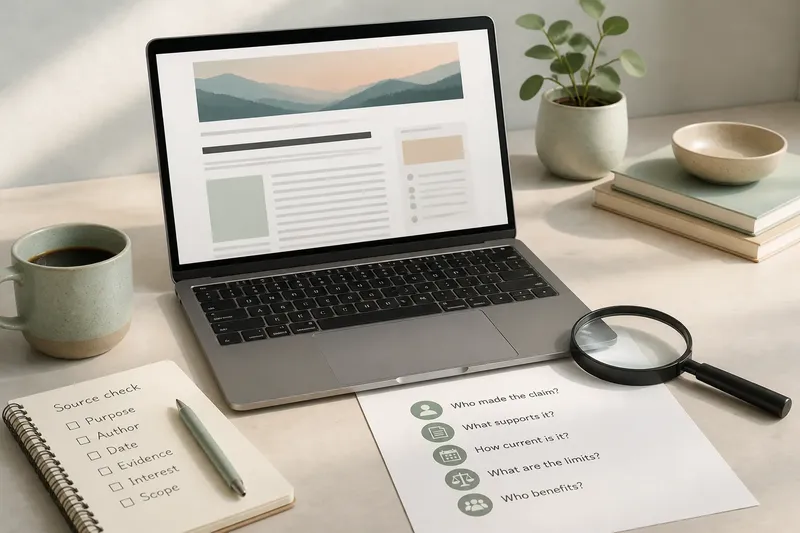
You recognise the site name, skim the headline and reach for the bookmark button. The familiar name feels reassuring, but it cannot tell you whether this particular page is current, well supported or speaking within its expertise. A source check begins with the claim in front of you.
To assess an online source, separate the organisation’s general reputation from the page’s specific evidence. That distinction helps you decide whether a page can support your point, offers useful context or is only a lead to investigate further.
Page purpose
First work out what kind of page you are reading. A news report, opinion column, product page, institutional guidance note and discussion thread make different promises, even when they share a well-known domain. A column offers an argument; a product page promotes an item; a guidance page may describe an organisation’s current position.
Look for section labels, calls to action and the language of the text. Words such as “opinion”, “sponsored” or “partner content” change how you should interpret a claim. So does the difference between a page explaining a policy and one expressing the author’s view of it.
Say you find an article on a familiar local newspaper site about a council decision. If it is marked as a reader contribution and centres on the writer’s response, treat it as commentary, not as the paper’s reporting of the decision. It may still help you understand one perspective, but it cannot stand in for a report on what happened.
Author and accountability
Look beyond the site logo and headline for a byline. A named author gives you a starting point: what role do they have, what experience is relevant to this subject, and are they writing as a reporter, specialist, advocate or organisation representative? A professional title may be relevant, but it does not establish that a particular claim is sound.
Some pages are signed by an editorial team, institution or agency rather than an individual. That can suit official guidance, but check whether the organisation is clearly responsible and whether the page explains its basis. An “About” page may clarify the organisation’s remit; it cannot replace evidence for the claim you need.
If there is no author, do not guess. A page without a byline may still point to a useful document, but it is harder to assess the writer’s expertise, interests and accountability. For a claim you intend to rely on, find a better-attributed source or trace the wording to its underlying material.
Dates and relevance
Find both the publication date and any update date. A recent update stamp does not necessarily mean every passage has been reviewed: it might reflect a small edit, a corrected link or a refreshed layout. Look for a note explaining what changed, then inspect the passage relevant to your question.
Age matters differently across subjects. An explanation of a stable concept may remain useful, while guidance about software interfaces, organisational policies, public services or current rules can become unreliable as circumstances change. Treat the date as a reason to ask a sharper question, not as a verdict by itself.
Keep the page’s date separate from the date of the event or document it discusses. A recent article can describe an older decision; an older page can point to a current source. Confusing those layers can make a claim appear more current than it is.
Claim and evidence
Choose the precise sentence you might use, then inspect the support closest to it. Does the page link to a primary document, identify who made the claim or explain how it reached its conclusion? A citation helps only if the material it leads to supports the wording on the page.
Watch for claims that grow stronger as they travel. A source may say an option is possible under certain conditions; a summary may turn that into a broad recommendation. Check whether qualifications, exceptions and uncertainty have survived. If the page quotes someone, read enough surrounding context to see what question the quotation answers.
Imagine a museum page says that an object was made in a named workshop and links to a catalogue entry. The entry describes the object but does not name the workshop. The museum may be reputable, yet that particular attribution remains unsupported by the linked material; mark it as uncertain or seek a source that addresses the attribution directly.
Expertise and interests
Expertise helps you judge a source; interest helps explain its framing. Ask who benefits if the page persuades you: a company selling a service, a campaign seeking support, an institution explaining its own decision or a journalist informing readers. An interest does not make a claim false. It does make the evidence and wording worth inspecting closely.
Separate factual claims from recommendations. A specialist may explain what a method does and then endorse a particular product; those are distinct claims and need different support. An organisation can accurately describe its policy while presenting the rationale in a favourable light.
Look for disclosures, funding notes, affiliations and links to promoted services. Their absence does not prove concealment, but it leaves an open question. Where a page is persuasive in purpose, compare its central factual claims with a source that has a different role.
Scope and boundaries
A page can be accurate within a narrow scope and misleading when stretched beyond it. Check its location, audience, definitions and exclusions. A rule for one region may not apply elsewhere; a guide for specialists may assume background knowledge; a summary may omit exceptions that matter to your question.
Read the opening and closing paragraphs as well as the highlighted passage. They may state what the page covers and what it leaves out. Follow links labelled “methodology”, “sources”, “terms” or “scope” when they bear on the claim. If a crucial boundary is unclear, do not extend the claim beyond what the page actually says.
If an answer depends on a product label, manufacturer instructions or local rules, consult the relevant source directly. For a consequential decision, ask a qualified professional. A general web page may help clarify the issue, but it should not be made to settle a question it was not written to answer.
Questions about source checks?
Does a familiar domain make every page reliable?
No. A recognised domain can host reporting, commentary, advertising, archived material and user contributions, each with different purposes and standards. Assess the individual page and the claim you intend to use.
What if a page has no author?
Check whether an accountable organisation is clearly responsible and whether the page links to underlying sources. If neither is clear, treat it as a lead rather than firm support for an important claim.
How can I tell whether an update matters?
Look for an explanation of the change and inspect the passage relevant to your question. A refreshed date without context may not tell you whether the information you need was reviewed.
When should I seek another source?
Look elsewhere when authorship, date or evidence is unclear, when the claim is stronger than its support, or when the page’s scope does not match your question. A second source is most useful when it addresses the same specific point independently.
Judgement and evidence
The familiar-name trap is not a reason to distrust every established site. Reputation belongs to an organisation; the evidence belongs to a particular page and claim. Check authorship, date, purpose and support, then state what the evidence does and does not establish.
For a compact source check, take an invented example: you need to confirm whether a council meeting approved a proposed change, and you have a newspaper article dated after the meeting. First, note that the article is a report rather than an opinion piece and identify its byline. Next, follow its link to the council minutes; imagine those minutes record that the proposal was discussed but deferred. Your answer is that the meeting did not approve the change, according to the minutes. The article remains useful for context, but the primary record supports the decision itself. This is why a familiar name should start your assessment, not finish it.